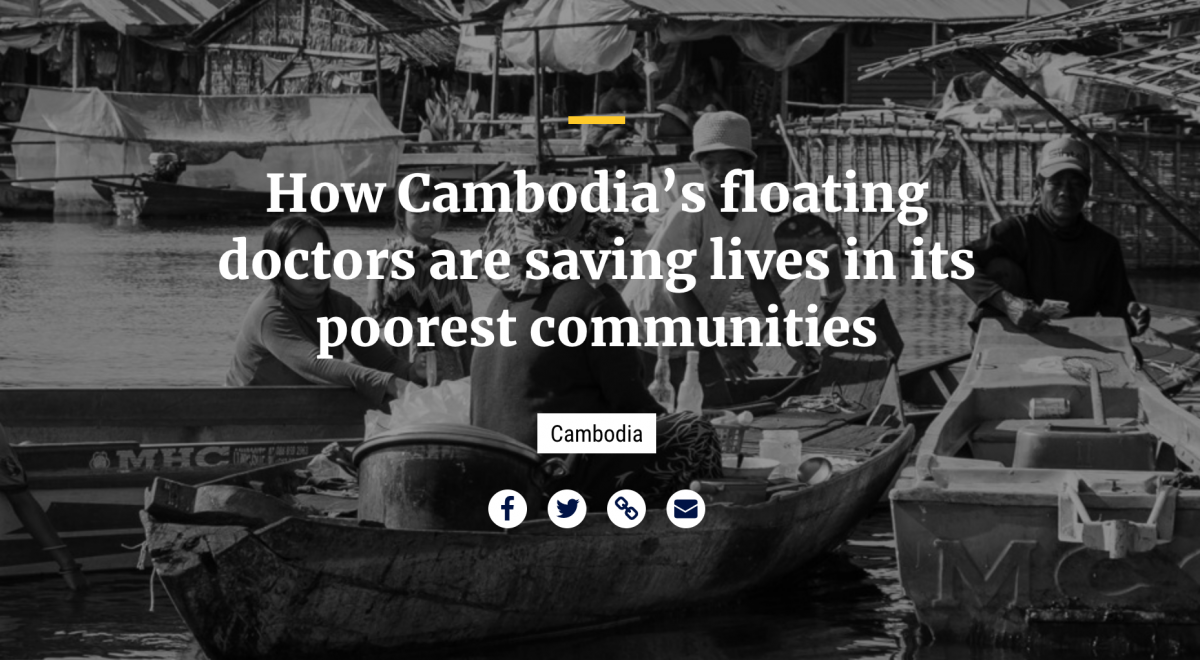
How Cambodia’s floating doctors are saving lives in its poorest communities

Tonlé Sap, in northern Cambodia, is the largest freshwater lake in Southeast Asia. During the May to October rainy season, it swells to six times its dry-season size, extending over 16,000 sq km – an area 200 times that of Hong Kong Island.

Tonlé Sap has also long been one of the planet’s most produc­tive inland fisheries. More than a million people depend on the lake for their livelihood, and about 100,000 live in its vicinity.

While many dwell in stilted villages on the lake’s flood­plain, the poorest huddle in floating communities on Tonlé Sap itself, sometimes hours from dry land. Their homes are often fragile, rain-leaking shacks cobbled together from woven reeds, scraps of plywood, tin sheets and tarpaulins, all lashed to wooden or bamboo rafts kept afloat on air-filled oil drums.

They are among the most isolated communities in Cambodia, the vast majority relying on subsistence fishing for their survival.

According to the World Health Organisation, Cambodia has just 1.7 doctors for every 10,000 people (Hong Kong has close to 20, according to government figures released last year). Floating communities on the lake have long had access to zero.

American Jon Morgan first became troubled by the lack of health care on Tonlé Sap in the 1990s, after completing his master’s in public health at the University of Hawaii.

Morgan, who went on to co-found the Angkor Hospital for Children, in nearby Siem Reap, noted the lake dwellers’ poverty, lack of education, poor nutrition and hygiene. Add to that the high fees for treatment, available only far from home, and it was a perfect storm of preventable diseases and treatable injuries that could ruin or end lives.

“I thought, my God, this is a nightmare,” says Morgan, now 67. “Somebody has to do something.”

His solution was The Lake Clinic – Cambodia (going, aptly, by the acronym TLC), which became a reality in 2007 and has grown in scope and ambition ever since. Through the years, TLC has provided more than 240,000 individual medical services to people living on Tonlé Sap, and today operates five “floating clinics” – four on the lake and one on the adjoining Stung Sen River – catering to more than 10,000 inhabitants in nine of the most underserved floating communities.

With five doctors, two nurses, four midwives, a dental nurse and support staff, funded purely by private donations, TLC’s two home-grown medical teams each make a three-day trip into the field every week. They live and work on offshore facilities, providing free medical care and health education to the most forgotten people in one of Asia’s poorest countries.

Link to the full article
Link to the Youtube video

New Generation Pedagogical Research Centre inaugurated

The Ministry of Education, Youth and Sport on Thursday inaugurated the New Generation Pedagogical Research Centre (NGPRC), located at the National Institute of Education.

It offers a Master’s Degree in Education in Professional Ethics, Teaching and Mentoring conferred upon graduates who have successfully completed a one-year course of the study.

“The goal of establishing this centre is to expand the scope of New Generation Schools (NGS), which are autonomous state schools that receive funds from the government and demand high quality of teaching that is aligned with the standards of 21st-century education,” the ministry said.

Pdf available here

Model schools teach a new generation of students

A central feature of Cambodia’s current education plan is the implementation of New Generation Schools, which aim to provide the Kingdom’s abler students with a thoroughly modern schooling. Post Education reports on the impact one NGS has made in the nation’s capital.

Throughout the eastern wing of Sisowath High School are corridors of new computer labs, science labs, modern wood-paneled classrooms, a multimedia library, and newly renovated administration offices carved above the old meeting rooms like suspended glass cubicles.

Pdf available here.

Bringing ICT knowledge into the classroom

The Ministry of Education, Youth and Sport (MoEYS), in response to the growth of the economy and society, has developed an Information and Communication Technology (ICT) Education strategy and is now integrating it into the national curriculum for students from Grade 4 to Grade 12.

In order to help students to have deeper understanding on ICT, InSTEDD iLab Southeast Asia, in partnership with MoEYS and KAPE (Kampuchean Action for Primary Education), plans to pilot Computer Programming to students from Grades 7-11 at New Generation School (NGS). Under the support from SPIDER, an independent public center with innovative programmes in Africa, Asia and Latin America, the Computer Programming had already been introduced to IT teachers and student at NGS.

Pdf available here.

Minister of Education meets with Microsoft

MINISTER of Education, Youth and Sport Hang Chuon Naron met with representatives of Microsoft on Wednesday at the National Sport Training Center in Phnom Penh to support the multinational firm’s assistance with the development and expansion of the New Generation Schools (NGS) programme.

The NGS initiative is a collaboration between the Ministry and the Kampuchean Action For Primary Education (KAPE) group, that seeks to raise the standard of classes for high-flying students, particularly in the field of science and technology.

Chuon Naron on Wednesday afternoon led a ceremony in which 48 computers were pledged by the Ministry to be donated to “Thun Thean Seksa” (TTS) high schools in 25 cities and provinces throughout the Kingdom.

Pdf available here.

Partnerships in Philanthropy That Deliver Lasting Results

The Pew Charitable Trusts works with philanthropists to make long-lasting, powerful, positive change—always based on solid research and tangible goals.

Through more than 70 years of working on important societal issues, we’ve learned that public-spirited individuals and organizations can change the world when they come together, exchange knowledge, and leverage resources. That’s why Pew seeks partners who share our commitment to serving the public good so that together we can deliver greater results.

Pdf available here.

Preah Sisowath High School, New Generation School, public education provides positive outcomes

Preah Sisowath High School is the premiere public high school in Phnom Penh. It recently instituted a New Generation School (NGS). The NGS is now 3 years old.

It has already benefitted learning outcomes for Cambodian students. We spoke to Vice Principal Sam Kamsann via email to learn more about the NGS, and about how students at New Generation School manage the transition to secondary education.

By using better accreditation systems to ensure effective learning with a high level of good governance, transparency, accountability and participation, all students are given greater chances of academic success.

Pdf available here.